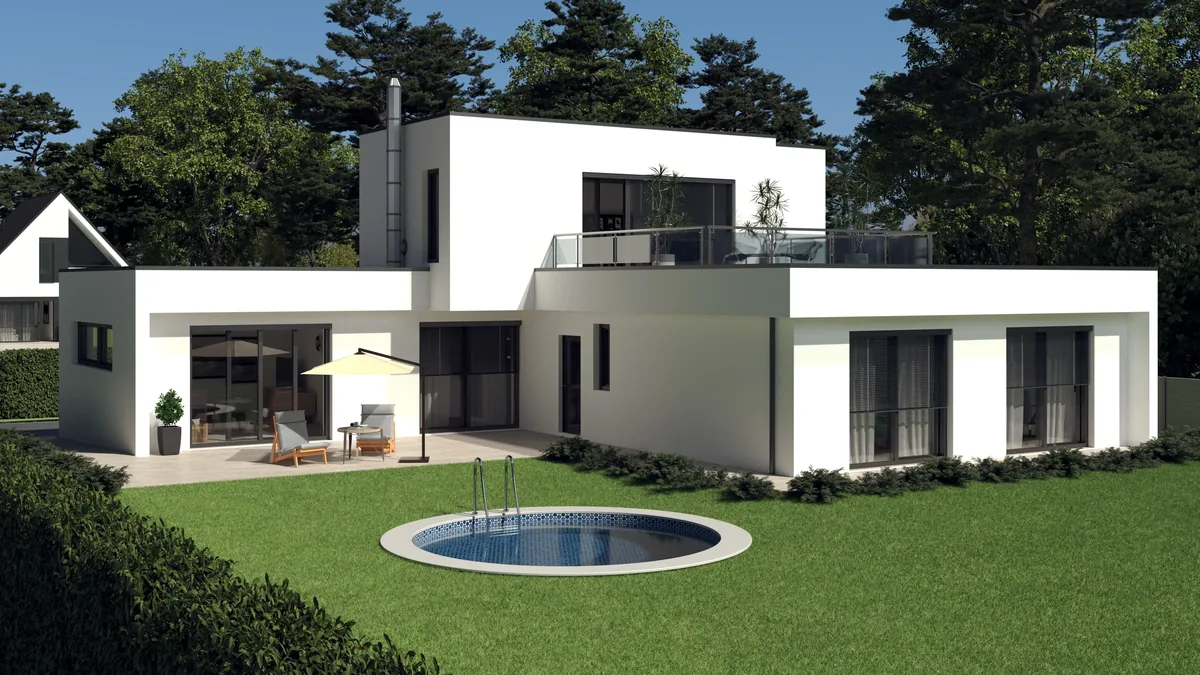
Photorealistic 3D interior & exterior rendering
Meticulous planning in interior and exterior design is hardly imaginable today without 3D visualization (rendering)—and for good reason. It allows existing 2D plans to be presented in a tangible way, enabling realistic reviews of drafts, quick comparisons of variants, and early adjustments. This leads to efficient, secure, and high-quality solutions in less time.
I offer this service to both corporate clients who demand high quality for their projects and private clients, especially when their manufacturers do not provide adequate visualization.
What You Receive
Photorealistic, High-Quality, Detailed 3D Images
Quality and attention to detail are paramount in these visualizations—especially in projects where existing elements are combined with new objects. Existing structures are modeled with precision so that the client immediately recognizes their space.
Process
01
Data Submission
You send me all project-related materials, plans, and material descriptions via email—ideally accompanied by reference images.
02
Drafting
Based on your materials, I first create photorealistic 3D visualizations in reduced quality for review.
03
Verification
You check configurations, textures, and details, and send me any necessary change requests.
04
Final Handover
I generate high-quality 3D renders and upload them to my cloud. You receive a download link via email. One revision (up to one hour of work) is included thereafter.
Service Highlights
3D interior rendering turns a floor plan into something you can judge. Interior design rendering places the actual furniture, at the actual dimensions, under the actual light, so proportion stops being a matter of imagination. An interior design 3d render answers the questions drawings cannot: whether the sofa dominates, whether the wall color reads warm or cold at this window orientation, whether the room still feels open once everything is in it. Decisions taken in front of a render are decisions you do not find yourself revisiting later.
3D interior rendering service quality depends entirely on what sits behind the image. Interior rendering services that model real products, real finishes and real dimensions produce a picture you can order from; ones using generic assets produce an illustration. Proper 3d rendering services interior design work delivers several views per room, material and lighting variants, and a model that stays editable so changes are cheap. You should be able to ask for the wall two tones lighter and see the result in the same week, not commission a new visualization.
Photorealistic interior rendering is not a luxury line on the invoice. It is the cheapest insurance available in a renovation: a single wrong kitchen front, ordered and fitted, costs more than visualizing the entire home. 3D interior visualization also settles disagreements, because two people who describe the same room differently in words agree instantly in front of an image. For anything custom-built, the render becomes the specification everybody signs off against — the carpenter, the electrician and the person paying for it.
You can see the room before ordering, and 3D interior rendering is how. Interior designers and specialist visualization studios build a model of the actual space with the actual dimensions, place the real products under a simulated version of your daylight, and produce images you can judge. Unlike a mood image, a render answers questions of proportion and volume: whether the sofa overwhelms the room, whether the wall color reads warm at this orientation, whether the space still feels open once everything is in it. It converts an act of imagination into an act of assessment.
A 3D interior rendering service typically delivers two to four views per room, one or two material and lighting variants, and revisions within a defined round. Turnaround for a single room is usually within one to two weeks, depending on how much of the specification is already fixed. What matters more than image count is what sits behind it: a model built from real product dimensions and real finishes can be edited cheaply and re-rendered, whereas a render assembled from generic assets has to be rebuilt whenever a decision changes.
On a small renovation, photorealistic rendering is usually worth it, and the arithmetic is straightforward. A single wrong decision — the wrong kitchen front, the wrong countertop, a color that has to be repainted — commonly costs more than visualizing the entire project. A render also settles disagreements: two people describing the same room in words rarely agree, and agree instantly in front of an image. For anything custom-built, the render doubles as the specification everyone signs off against before the carpenter cuts material.