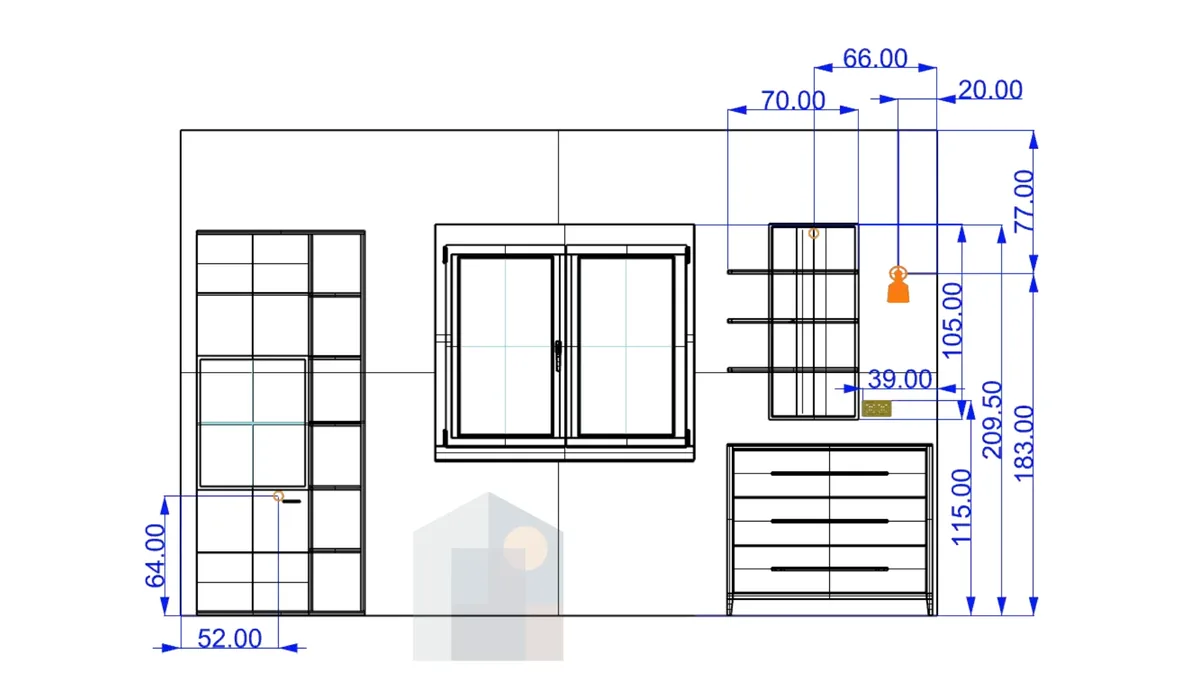
Working drawings with dimensions
Communication between end customers and contractors can be challenging, especially in complex projects like interior planning. Using 3D visualizations and technical, dimensioned sketches, your ideas are presented clearly and understandably.
Design becomes tangible, making collaboration easier and optimizing the final result. Additionally, you receive a complete product list, which significantly simplifies the purchasing of furniture and materials.
What You Receive
Dimensioned Room Views
Detailed room views with dimensions for architectural elements, wall and floor designs, and furniture. These serve as a basis for coordination with your executing contractors.
Lighting & Electrical Overview
You receive sketches indicating the positions for electrical connections and lighting, which should be reviewed and adjusted with your contractors.
Product List
A comprehensive list of selected furniture and decorations, including prices and links where available.
Process
01
Materials
You will receive a complete list of all materials for the project via email.
02
Data Review
It is crucial that you carefully review all sketches and drawings. This is the stage to make any final adjustments to placement or design.
03
Final Data Handover
Finally, you receive a PDF document containing all material details—essential for construction firms—along with a separate shopping list.
Service Highlights
Interior design working drawings are the document that stops a good concept being built badly. Interior working drawings give every trade the same dimensioned reference: wall elevations, built-in furniture, tiling layouts, lighting and socket positions, floor transitions. Without them, each of those decisions is taken on site by whoever happens to be standing there when the question comes up. With them, the room that gets built is the room that was designed, and disputes about what was meant do not arise.
The set covers dimensioned floor plans, wall elevations for every room containing built-in elements, a lighting and electrical layout with switch and socket positions, and material references keyed to each surface. Interior design working drawings are produced at the scale trades actually work at, with tolerances stated wherever they matter. Where a detail is critical — a mitered joint, a shadow gap, a flush transition between two floor materials — it gets a detail drawing of its own rather than a note.
You need working drawings when carpentry is custom, when walls move, or when more than two trades have to coordinate around the same surfaces. If you already have a design you like and no way to hand it over, this is the missing document. It is also the point at which a fixed quote becomes possible: builders price accurately from drawings, and price defensively without them. The set usually costs less than the contingency it removes from the quote.
Interior working drawings are produced by an interior designer, an interior architect or a technical draftsperson working from an approved concept. They translate a design into the dimensioned, buildable information a carpenter, electrician or tiler needs: wall elevations, built-in furniture details, tiling layouts, lighting and socket positions, and floor transitions. Without them, every unresolved dimension becomes a decision taken on site by whoever is standing there. With them, what gets built matches what was designed, and disagreement about intent does not arise.
For a trade to price accurately, a drawing set needs dimensioned floor plans, wall elevations for every room containing built-in elements, an electrical and lighting layout with positions and heights, and material references keyed to each surface. Critical junctions — a mitered joint, a shadow gap, a flush threshold between two floor finishes — need their own detail drawings rather than a written note. Drawings should be issued at the scale trades actually work at, with tolerances stated where they matter, and revisions numbered so nobody builds from a superseded sheet.
Small projects need working drawings whenever anything is made to measure. The size of the project is not what creates the risk; custom fabrication is. A single fitted wardrobe involves dimensions, material thicknesses, door clearances and a wall that is rarely square, and all of it has to be agreed before cutting begins. A drawing set is also what makes a fixed price possible: trades price accurately from drawings and add contingency without them, so the set frequently costs less than the margin it removes from the quotation.