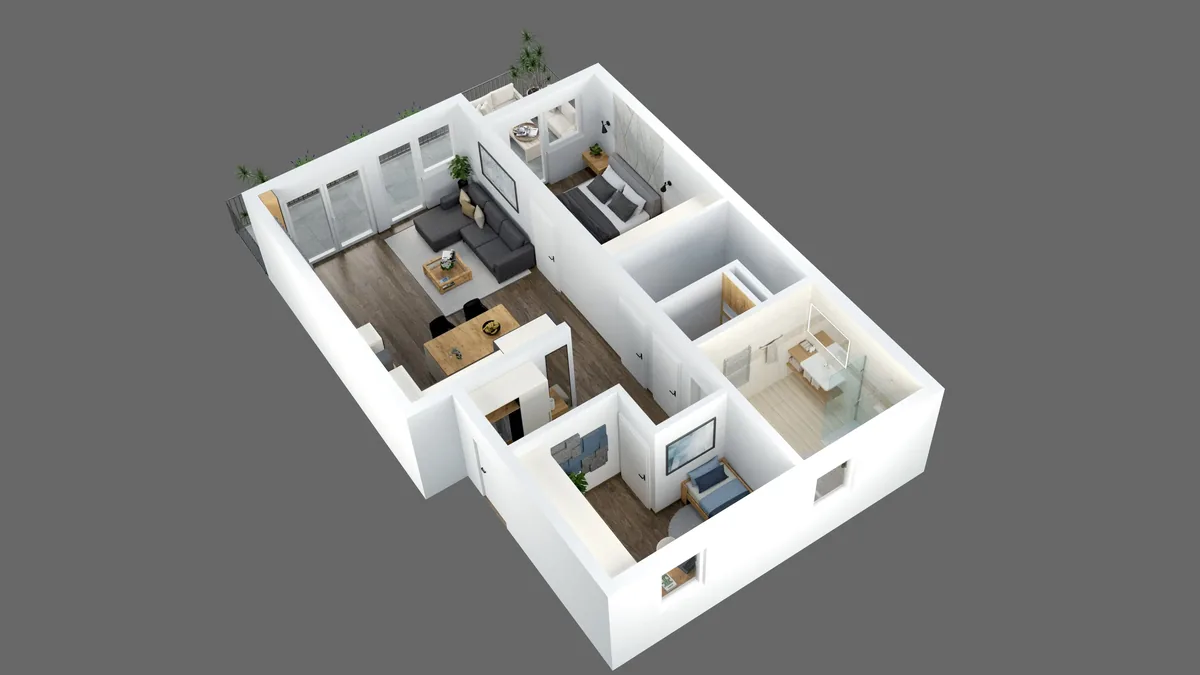
Floor plan review and optimisation
Many people focus only on the number of rooms and square footage. But for a decision as important as choosing a home, that isn't enough! Does the layout suit your daily routine? Will your furniture fit? Is the ergonomics sound? This is where the difference between a gut feeling and a well-informed choice lies.
An unsuitable floor plan can make daily life unnecessarily difficult. That is why I offer a professional floor plan analysis: we check functionality, ergonomics, and everyday usability, uncovering critical zones and developing tailored solutions for a home that truly fits your life.
What You Receive
Functionality Check
We review room assignments, spatial relationships, the logic of circulation paths, and the positioning of windows.
Ergonomics Check
We verify that circulation areas are adequately sized and that door openings don't conflict with furniture. We also estimate clearances relative to your future furnishings.
Everyday Usability Check
We analyze storage potential, check if the space can be furnished without expensive custom solutions, and test for flexible usage.
Optimal Space Utilization
Using a 3D floor plan, we define clear utilization zones. This gives you a precise understanding of what is possible in the apartment or house—and where the limits are.
Process
01
Needs Analysis
Through targeted questions, we determine what you and your family require from a home.
02
Data Processing
Based on your provided materials, I create a 3D floor plan including furnishings.
03
Online Meeting (60 Min.)
We develop the interior layout using the 3D model and perform practical exercises to test the space.
04
Data Handover
You receive a finalized 3D floor plan with furnishings via email, along with a report detailing all the pros and cons of the layout for your specific needs.
Service Highlights
Space planning is the discipline that decides whether a home works, and it happens before anything is bought. A space planning service examines circulation, sightlines, storage and the way daylight moves through the day, then proposes an arrangement that fits how you actually live. Room layout planning done on paper costs hours; done after the wardrobes are installed it costs a rebuild. This is the cheapest intervention available anywhere in the design process, and the one whose consequences are hardest to reverse once construction has started.
Room design layout questions are rarely abstract. A bedroom layout has to resolve wardrobe depth against walking space. A living room has to seat people facing one another without blocking a door. A home office needs the desk out of the glare and the cables out of sight. Room layout planning starts from the fixed constraints — window positions, radiators, door swings, sockets — and works outward. Where constraints genuinely conflict, you get the trade-off stated plainly rather than a compromise presented as a solution.
A floor plan review service earns its fee at two moments: before signing for a property, and before approving a builder's drawings. Both are points where a plan looks fine and hides a problem — a kitchen with no wall for the fridge, a bathroom door that swings into the basin, a bedroom that cannot take a standard bed with clearance on both sides. Space planning at this stage costs a fraction of the change order it prevents, and days rather than the weeks a variation adds to a build.
A floor plan can absolutely be reviewed before you sign, and it is one of the highest-value checks available to a buyer. A floor plan review service reads the plan for the problems that are invisible until you move in: a kitchen with no uninterrupted wall for appliances, a bathroom door swinging into the basin, a bedroom that cannot take a standard bed with clearance both sides, circulation that cuts a living room in half. The review costs a fraction of one month's mortgage and occasionally changes the decision entirely.
Furniture fits when planning starts from constraints rather than from wishes. Room layout planning begins with what cannot move — window positions, radiators, door swings, sockets, ceiling heights — then places the largest item first and works down. Clearances are the part most people underestimate: circulation routes, drawer and door swing, and the space needed to sit down and stand up at a table. Measuring the actual furniture rather than trusting a catalog image is what separates a layout that works from one that looks correct on paper.
A room planner app arranges what you tell it to arrange; a space planning service tells you what to arrange. The app is a drawing tool without judgment — it will let you place a sofa across a doorway and a wardrobe where the door swing meets it. A professional space planning service brings the ergonomic standards, circulation dimensions and daylight reasoning that the app has no opinion about, and it says no to arrangements that will not work in use. The app is useful afterwards, to visualize a decision already taken correctly.