
The right rug size: 4 principles for a calm room layout
In short
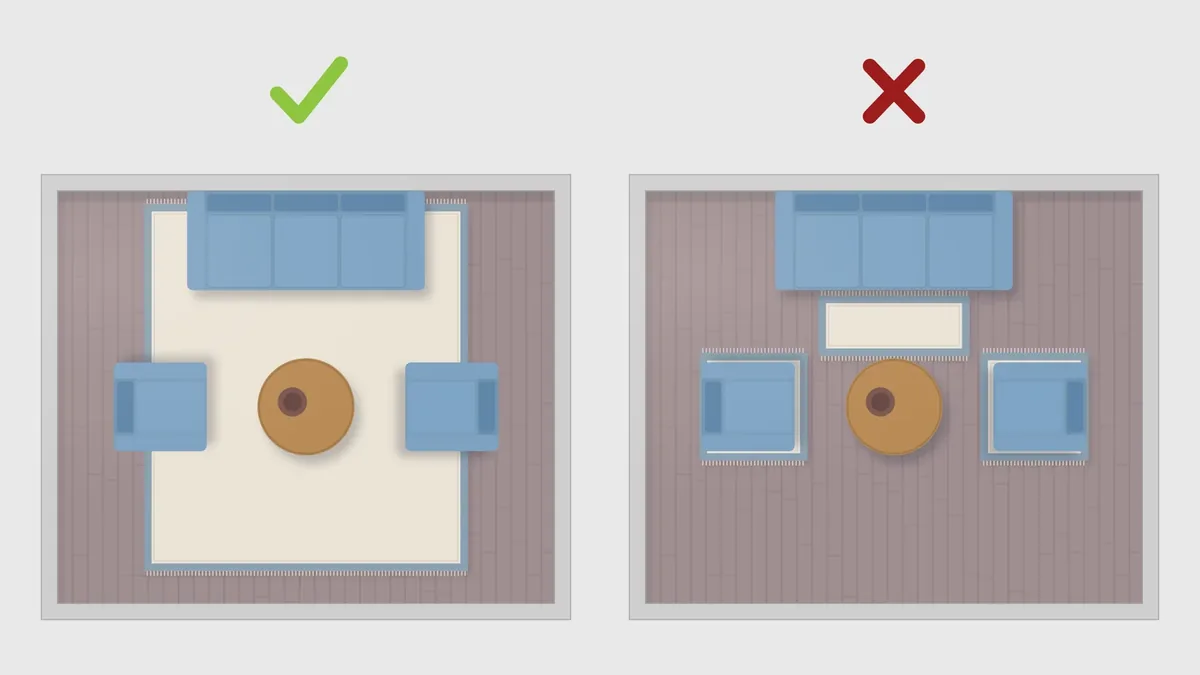
Place the rug in the center of its zone – under a bed, shifted toward the foot end – and let every piece of furniture in the zone stand half or fully on it, never right on the edge. Leave 10 to 15 centimeters between rug and wall, and let the rug extend 10 to 15 centimeters beyond each side of the sofa. Allow about 60 centimeters of rug beside and in front of the bed, so your feet land somewhere warm.
A rug is much more than decoration. In any room layout, it does several jobs at once:
- Accent: color, pattern and texture create a focal point.
- Zoning: it shows where living, dining or sleeping begins – especially in open-plan spaces.
- Protection: it protects the floor from scratches and your feet from the cold.
- Acoustics: it absorbs sound and reduces echo.
- Comfort: it makes a room feel softer and warmer.
- Connection: it picks up colors from the room and ties everything together.
- Guidance: a runner naturally leads the way down a hallway.
This article is about size – because that's where most mistakes happen. A rug that's too small looks lost and makes the whole room feel smaller and a little odd. A rug that's too big turns into a second floor, and suddenly the room feels cramped.
You'll find plenty of rules online: how many furniture legs should stand on the rug, how much space to leave, and so on. Instead, I'd like to give you four principles you can apply to any situation.
Principle 1: Center the rug in its zone
A rug defines a zone, so it belongs in the middle of that zone. Whether it's a dining table, a seating area or a bed, centering the rug is usually the best choice.
- Dining table: this one is easy – the rug sits centrally under the table.
- Seating area: the position depends on which pieces belong to the group, but the sofa is always the main character.
- Bed: the zone includes the space you need to get in and out of bed, at the sides and at the foot. That's why the rug is often not centered under the bed but shifted toward the foot end.
If you're working on your room layout planning, define the zones first and choose the rugs afterwards. That's exactly what we do in the Floor Plan Check: a 3D floor plan with clear zones for how you use each space.
Principle 2: Everything in the zone belongs on the rug
This doesn't necessarily mean fully on the rug – we'll get to that in principle 3. What matters is that every piece of furniture in the zone stands on the rug or touches it. That's how our brain understands that these pieces form a group.
Sometimes I see rooms where almost every piece of furniture has its own small rug. This breaks the space into fragments and makes it feel restless. One larger rug that holds the whole group together looks much calmer.
Principle 3: Nothing sits on the edge
A piece of furniture should never stand with its edge or legs exactly on the edge of the rug. It looks undecided, and it often wobbles too. Instead:
- Half and half: move the piece further in, so it stands half on the rug and half on the floor.
- Fully on: if the size allows, place it completely on the rug.
At the dining table, it's usually most practical when the chairs stand fully on the rug – even when they're pulled back. That way they don't wobble or catch on the edge when you move them.
This principle also covers the distance to the wall. Rather than laying the rug flush against the wall, leave 10–15 cm of breathing room. And with a sofa, it looks better when the rug isn't exactly as wide as the sofa but extends 10–15 cm on each side. Similar proportion rules also help when you hang pictures the right way.
Principle 4: Protect your feet
This matters most in the bedroom layout. When you get up in the morning, you'd rather land on a soft rug than on a cold floor. So plan about 60 cm of rug at the side, at the foot, or both. That gives you a comfortable strip to walk and stand on.
Test the rug size before you buy
Before you order, mark the rug's dimensions on the floor with painter's tape. You'll see straight away whether all the furniture in the zone stands on the rug, whether anything sits on the edge, and whether there's enough space to the wall.
If you'd like to see your room finished before you buy anything, I'm happy to help. With IMAGO, we plan your room completely in 3D, including furniture selection and flooring. And with a 3D interior rendering, you can see in photorealistic detail how rug, furniture and lighting work together. For an even cozier feel, take a look at my post on cozy living room lighting.